The Price of a Perfect Cup: Ethiopia's Coffee Economy and the Justice Gap American Consumers Rarely See
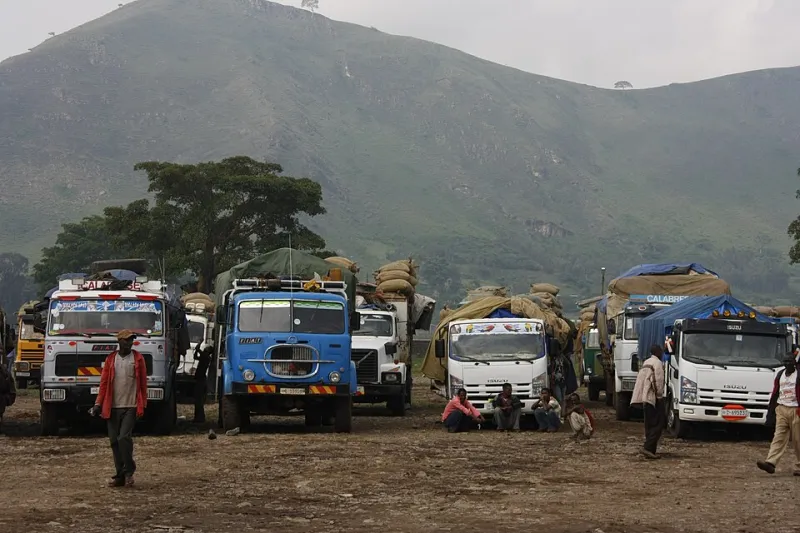
Photo: DFID - UK Department for International Development, CC BY 2.0, via Wikimedia Commons
On any given morning in an American city—Seattle, Brooklyn, Chicago, Austin—a customer orders a single-origin Ethiopian pour-over, hands over somewhere between six and twelve dollars, and receives in return a beverage whose origin story is almost entirely invisible to them. The cup is described on the menu with the language of artisanal romance: notes of jasmine, bergamot, stone fruit. The region of origin—Yirgacheffe, Guji, Harrar—is printed in a font designed to evoke authenticity.
What the menu does not describe is the farmer in the Gedeo Zone who grew those cherries, earned perhaps two dollars a day during harvest season, and has no meaningful visibility into what becomes of the beans once they leave her cooperative. That omission is not incidental. It is structural. And understanding it requires looking honestly at the intersection of colonial commodity logic, contemporary capitalism, and a country that is now—with considerable urgency—attempting to rewrite the terms of its own economic participation.
The Birthplace of Coffee, the Last to Profit From It
Ethiopia is not merely a major coffee producer. It is, by the preponderance of historical and botanical evidence, the place where coffee as a cultivated crop originated. The forests of Kaffa in southwestern Ethiopia gave the plant its name. The beverage that animated Ottoman coffeehouses, powered the European Enlightenment, and eventually became the organizational principle of American morning routines traces its lineage to Ethiopian soil.
This is not a trivial historical footnote. It is a foundational fact that carries significant moral and economic weight when one examines the distribution of value in the contemporary global coffee trade. Ethiopia exports approximately 250,000 to 300,000 metric tons of coffee annually, making it the largest coffee producer in Africa and one of the top producers globally. Coffee accounts for roughly 30 to 35 percent of the country's total export earnings. It is, by any measure, Ethiopia's most strategically important commodity.
Yet the financial architecture of the global coffee market ensures that the overwhelming majority of the value created from Ethiopian coffee is captured elsewhere—in the roasting facilities of Northern California, the commodity trading floors of New York and London, and the retail margins of multinational café chains. Ethiopian farmers, operating within a supply chain characterized by multiple intermediary layers, receive a fraction of the final consumer price. Studies examining commodity chain economics in coffee consistently find that producing-country actors capture between 10 and 25 percent of final retail value, with significant variation depending on market channel and certification status.
Fair Trade's Promise and Its Limits
The fair-trade movement, which gained considerable traction among American consumers in the 1990s and 2000s, was designed in part to address precisely this inequity. By establishing minimum price floors and requiring certified producers to meet labor and environmental standards, fair-trade certification promised a more equitable distribution of coffee's economic rewards.
The reality has been more complicated. Fair-trade certification does provide measurable benefits to participating cooperatives—access to premium prices, technical assistance, and organizational capacity building. Ethiopian cooperatives in regions such as Sidama and Yirgacheffe have benefited from these mechanisms. The Oromia Coffee Farmers Cooperative Union, one of the largest fair-trade certified cooperatives in Africa, has used premium revenues to fund schools, health clinics, and water infrastructure in member communities.
But fair-trade's structural limitations are now well documented. Certification costs create barriers to entry for smaller or more remote cooperatives. The fair-trade price floor, when global commodity prices rise above it, becomes irrelevant. And the certification system itself is administered largely by organizations based in the Global North, raising questions about governance, accountability, and whose definition of fairness actually prevails.
Perhaps most critically, fair trade operates within the existing commodity market architecture rather than challenging it. It improves conditions within a fundamentally asymmetric system without altering the system's underlying power relations.
Ethiopia Moves to Rewrite the Terms
The Ethiopian government has, over the past fifteen years, undertaken a series of policy interventions designed to capture greater value from coffee before it leaves the country. The establishment of the Ethiopian Commodity Exchange in 2008, while controversial in its initial design, represented an attempt to create price transparency and reduce the exploitation of farmers by informal traders operating with significant information advantages.
More assertively, Ethiopia has pursued intellectual property protections for its most distinctive coffee varieties. A celebrated dispute with Starbucks in the mid-2000s, in which the Ethiopian government sought trademark recognition for Yirgacheffe, Harrar, and Sidama coffee names in US and European markets, illustrated both the stakes involved and the resistance such efforts encounter from established commercial interests. Ethiopia ultimately secured agreements with Starbucks and other roasters, though the long-term commercial impact of those arrangements has been the subject of ongoing debate among development economists.
More recently, the government's push to encourage domestic value-added processing—expanding roasting and packaging capacity within Ethiopia rather than exporting exclusively as raw green beans—reflects a strategic logic that is both economically sound and politically resonant. Processed coffee commands significantly higher prices than commodity green beans, and the employment generated by roasting and packaging industries represents a qualitative improvement in the type of economic activity coffee supports.
Climate Change and the Compounding Crisis
Overlaying all of these structural tensions is the accelerating threat of climate change, which poses an existential risk to Ethiopian coffee production as currently configured. Research published in peer-reviewed agricultural journals has projected that significant portions of Ethiopia's current coffee-growing areas could become climatically unsuitable by mid-century under moderate warming scenarios. Higher temperatures, shifting rainfall patterns, and the spread of coffee diseases such as coffee wilt and coffee berry disease—all of which are exacerbated by climatic instability—threaten the very foundation of the country's most important export sector.
For American consumers who have developed deep attachments to specific Ethiopian single-origin profiles, this is not an abstract concern. The distinctive flavor characteristics of Yirgacheffe coffee—those jasmine and citrus notes that specialty coffee culture has elevated to near-mythological status—are the product of a specific terroir that is under genuine threat. The loss of that terroir would be an irreversible cultural and economic impoverishment.
This reality creates a convergence of interests between Ethiopian farmers, global coffee companies, and climate-concerned American consumers that has not yet been adequately mobilized into coherent policy or market response.
What American Coffee Culture Owes to This Conversation
The specialty coffee movement in the United States has, to its credit, done more than most commodity sectors to foreground questions of origin, producer relationships, and supply chain ethics. The "third wave" coffee culture that now dominates urban American café life has made Ethiopian coffee a centerpiece of its identity, and in doing so has created consumer audiences that are, in principle, receptive to more honest conversations about economic justice.
The challenge is translating that receptivity into structural change. Paying four dollars more for a bag of coffee labeled "direct trade" is not, by itself, a policy intervention. What is needed is a combination of consumer pressure, corporate accountability, trade policy reform, and genuine partnership with Ethiopian institutions—governmental, cooperative, and civil society—that treats Ethiopia as a sovereign economic actor rather than a picturesque source of artisanal ingredients.
The cup in your hand this morning is the product of a history that is older, more complex, and more politically charged than its menu description suggests. Acknowledging that complexity is not a burden. It is, in fact, the beginning of a more honest relationship between American consumers and the country that gave the world coffee in the first place.