Water, Power, and the GERD: What Ethiopia's Mega-Dam Means for the Future of African Geopolitics
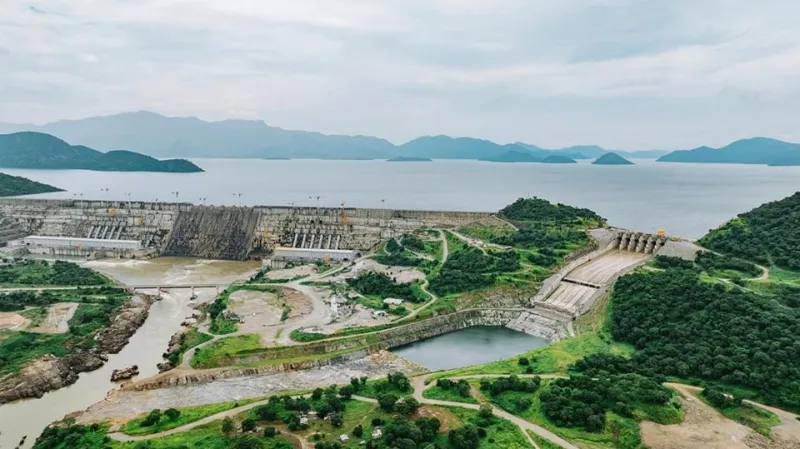
Photo: Prime Minister Office Ethiopia, Public domain, via Wikimedia Commons
When Ethiopia began diverting the Blue Nile in 2013 to make way for what would become the Grand Ethiopian Renaissance Dam (GERD), the act was more than a feat of engineering. It was a sovereign declaration—a statement that a nation long associated in Western imagination with drought and dependency was now asserting control over one of the world's most consequential waterways. Nearly a decade later, as the dam's third turbine comes online and its reservoir continues to fill, the GERD has become the most consequential infrastructure project in contemporary African geopolitics.
For American audiences accustomed to viewing African disputes through a humanitarian lens, the GERD demands a different framework entirely: one rooted in international law, resource sovereignty, and the shifting geometry of regional power.
A Colonial Agreement at the Heart of a Modern Conflict
To understand why Egypt views the dam with such alarm, one must revisit history. The 1929 Anglo-Egyptian Treaty—and its 1959 successor—allocated the vast majority of Nile waters to Egypt and Sudan, effectively sidelining the upstream nations whose territories feed the river. Ethiopia, the source of roughly 85 percent of the Nile's flow through the Blue Nile tributary, received no formal allocation under these agreements.
Addis Ababa has long regarded these colonial-era treaties as illegitimate instruments designed to serve British imperial interests rather than equitable regional development. The GERD, from Ethiopia's perspective, is not an act of aggression—it is a correction. Cairo, however, frames the dam as an existential threat to a country where nearly all arable land depends on Nile irrigation. Egypt's Foreign Ministry has repeatedly appealed to international bodies, including the United Nations Security Council, arguing that Ethiopia's unilateral filling of the reservoir violates downstream rights.
Sudan's position has been notably more ambivalent. Initially aligned with Egyptian concerns, Khartoum has gradually recognized that the dam may actually benefit Sudanese agriculture by regulating seasonal flooding and improving water flow predictability. This shift has complicated what Egypt hoped would be a unified downstream front, revealing how the GERD has fractured old alliances and forged unexpected pragmatism.
Development as Diplomacy
Ethiopia's approach to the GERD negotiation reflects a broader diplomatic philosophy increasingly visible across the African Union: that infrastructure investment is inseparable from sovereignty. The dam is projected to generate over 5,000 megawatts of electricity at full capacity—enough to power Ethiopia's domestic needs and export surplus energy to neighboring countries, including Djibouti, Kenya, and potentially Sudan itself.
This economic calculus is central to Ethiopia's soft power argument. By positioning the GERD not merely as a national project but as a continental energy solution, Addis Ababa has sought to reframe the dispute from a bilateral water conflict into a question of African development solidarity. It is a strategy with considerable resonance. The African Union, headquartered in Addis Ababa, has served as the primary mediating body for GERD negotiations—a deliberate choice by Ethiopia that keeps Western and Arab League influence at arm's length.
For US policymakers, this preference for African-led mediation carries significant implications. Washington's leverage in Horn of Africa diplomacy has historically depended on bilateral relationships and aid conditionality. The GERD dispute signals that Ethiopia—and by extension, a growing cohort of African states—is actively constructing diplomatic architectures that reduce dependence on external arbiters.
Climate Adaptation and the Infrastructure Imperative
Beyond the immediate political contest, the GERD sits at the intersection of two of the most consequential global challenges: climate change and energy poverty. Sub-Saharan Africa contributes less than four percent of global carbon emissions, yet its populations face disproportionate climate vulnerability. Hydroelectric infrastructure, despite its own ecological trade-offs, represents one of the few scalable low-carbon energy pathways available to developing economies without access to the capital markets that finance solar and wind projects at scale.
Ethiopia's insistence on proceeding with the GERD—even in the absence of a binding trilateral agreement—reflects a calculated prioritization of climate adaptation over diplomatic consensus. This is not recklessness; it is a response to decades of stalled negotiations that consistently deferred Ethiopian development interests in favor of downstream stability.
The dam's reservoir also raises legitimate concerns about evaporation losses in a warming climate, reduced sediment flow affecting Sudanese and Egyptian agriculture, and the long-term viability of hydropower as regional temperatures rise. These technical dimensions have been insufficiently integrated into the political dialogue, suggesting that durable resolution will require scientific cooperation as much as legal negotiation.
What Washington Should Be Watching
The Biden administration's engagement with the GERD dispute was largely reactive, oscillating between statements of concern and calls for African Union-led dialogue. The Trump administration's brief attempt to broker a deal in 2020—which Ethiopia ultimately rejected as biased toward Egyptian interests—illustrated how poorly calibrated external mediation can harden positions rather than soften them.
A more effective US posture would begin with recognition that the GERD is not primarily a crisis to be managed but a precedent to be understood. As African nations increasingly leverage infrastructure to assert sovereignty and reshape regional hierarchies, Washington's ability to remain a credible partner on the continent will depend on its willingness to engage with African-defined development priorities rather than impose externally derived frameworks.
The dam also has implications for US-China competition in Africa. China's Export-Import Bank provided significant financing for the GERD's early phases, and Beijing has positioned itself as a non-interventionist infrastructure partner—a contrast that African governments frequently note when evaluating Western alternatives. If the United States wishes to remain relevant to Africa's infrastructure decade, it must offer not just financing but genuine respect for the sovereignty that infrastructure projects like the GERD embody.
A River's Meaning
The Nile has sustained civilizations for millennia. Its waters have been fought over, prayed over, and mythologized across cultures that predate the nation-states now contesting its allocation. The GERD does not resolve this ancient tension—it intensifies and modernizes it.
What the dam ultimately reveals is that Africa's most consequential policy debates are no longer being shaped primarily in Washington, Brussels, or Beijing. They are being shaped in Addis Ababa, Nairobi, and Cairo—by governments that have learned to deploy infrastructure as a language of power. The United States would do well to learn that language before the next dam is built.